
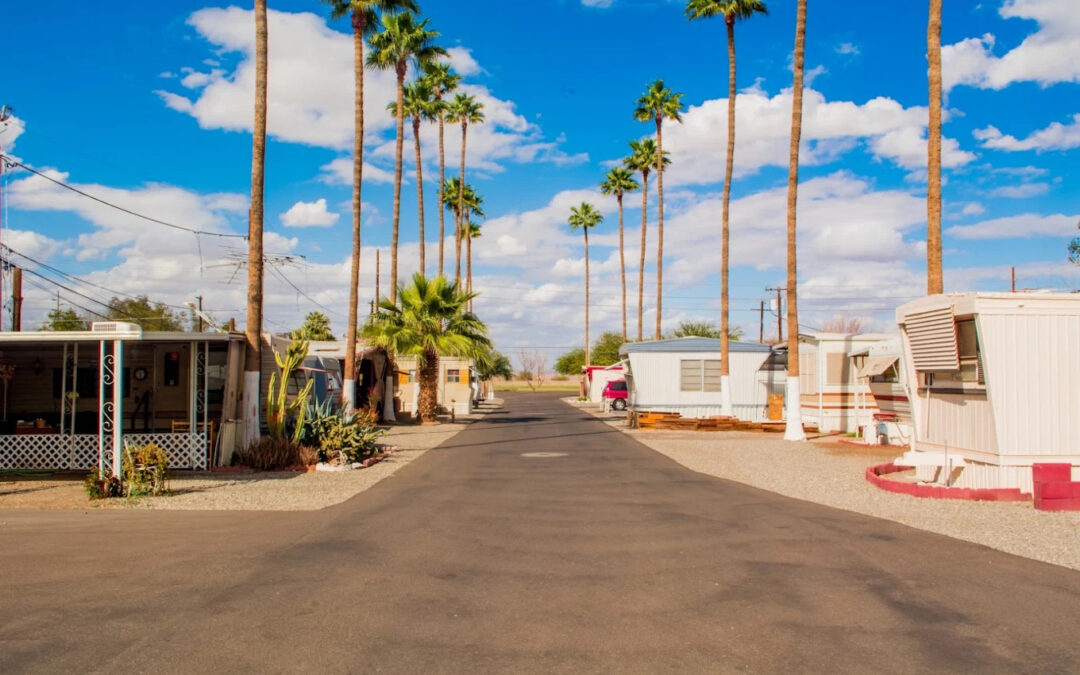
Renting a trailer lot usually means you rent only the space under your home, so you typically bring and own the home while the park supplies the land and the shared parts of the community. Renting a full mobile home means the landlord owns the home, so you pay for the structure and the space together and the lease sets who handles repairs. Before you search for trailer lots for rent near you, decide what kind of trailer you have, because “trailer lot” is a search phrase and not a legal category, and a mobile home and a travel trailer fall under different Arizona rules.
| Renting a lot | Renting a full mobile home | |
| What you rent | The space only | The home and the space it sits on |
| Who owns the home | Typically you | The landlord |
| Who pays for repairs | The owner, which is typically you, subject to your agreement and the law | Set by your lease and the law |
| Monthly cost | Space rent, plus any utilities the rent does not cover | Rent set by the lease, plus any utilities it does not cover |
| What you need first | A home the park accepts, plus moving and setup | A lease, with deposit and application terms spelled out in it |
| If you leave | You sell, move or remove your home, and your agreement still applies | You settle the lease terms, such as notice, condition and charges |
Why Does a Lot Listing Leave So Many Questions?
A search for trailer lots for rent near me returns a long list of addresses and monthly prices. It rarely says what the listing includes.
The word trailer causes much of the confusion. For one person it means a mobile home. For another it means a travel trailer or an RV. In both cases a lot is only a space. The home or the trailer is yours to bring.
That makes renting a lot a different deal from renting a full mobile home. You take on the home, its repairs and the move. In return you pay for the ground and the shared parts of the park, not for the structure.
This guide explains the difference in plain words, with Arizona rules where they apply. It is general information, not legal advice, so for a specific deal, talk to an Arizona attorney who handles mobile home park law.
What Does “Trailer Lot for Rent” Actually Mean?
A trailer lot is a space in a park where you place your own home or trailer and pay rent for the ground. People also call it a lot or a space. It is a consumer search phrase, not a single legal category, so the law that applies depends on the unit, the park and the rental arrangement.
Arizona law uses the words mobile home space. It defines a mobile home space as a parcel of land for rent designed to accommodate a mobile home, a mobile home park as a parcel with four or more mobile home spaces, and a mobile home as a residential structure built on or before June 15, 1976, or a later manufactured home that originally bore an appropriate insignia of approval, while excluding recreational vehicles and certain park model trailers.
That definition sorts “trailer” into two groups. If your home meets it, the mobile home park rules apply to your space. If your trailer is a travel trailer or an RV, a separate Arizona law may apply instead, and a later section shows where the two differ.
How Do You Know Which Kind of Trailer You Have?
Start with the home itself. Find out when it was built, and look for the insignia of approval that the definition above mentions. The title, the sales papers and the label on the home can help. If you bought the home used, ask the seller for any papers that came with it.
A label alone may not settle every question. Confirm the unit’s classification from its records and from the park before you pay to move it. Get the park’s answer in writing, along with the name of the person who gave it.
If the paperwork does not match what the park tells you, resolve that before you commit to the move or pay a deposit.
What Do You Need Before a Park Will Rent You a Lot?
A lot is not open to every home. The park decides what it accepts, and the rules are written down. A park’s statement of policy covers the size and other specifications of homes allowed, including whether a home must be new or used and whether it must be set at or above ground level, along with any improvements you must provide and their estimated cost, and whether the park is a family community or a community for older persons. The park must give it to you before you sign the rental agreement, and it must be attached to that agreement.
Read the statement of policy before you move anything. A home that does not meet it may not be allowed, and finding that out after the move is expensive.
Then look at the application. Does the park require one? What does it ask for? Is there a fee, and who in your household has to apply? Collect the rental agreement and the park’s written rules at the same time, and read all three together.
Finally, get written quotes for moving and setting up the home. When you bring your own home, those costs are yours, and they come before the first month of rent.
How Does Renting a Lot Differ From Renting a Full Mobile Home?
Who owns the home, and who fixes it?
If you rent a lot, you typically own the home, so you are generally responsible for maintaining it, subject to your agreement and the law. The park looks after what its agreement says it looks after, such as shared areas.
If you rent a full mobile home, the landlord owns it. Your lease and the law decide who handles repairs. Settle before you sign who pays for the air conditioner, the water heater and the roof, and get the answer in writing.
What do you pay each month?
On a rented lot you pay space rent for the land. Your agreement decides whether water, sewer, trash and other utilities are included, so find out which ones are not. Check too whether the park requires insurance on the home, how long the term runs, and how the park can change the rent at renewal.
On a rented home you pay the rent the lease sets, and the same questions apply. What is included, and what is billed on top?
In both cases, add every line before you compare. A lower listed rent does not always mean a lower monthly total.
What does it cost to move in?
When you rent a lot, the large costs belong to the home. You may already own it. If not, you must buy one or move one in. Add moving and setup, any improvements the statement of policy requires, and whatever the park charges to apply.
When you rent a full mobile home, the costs sit in the lease. Request a written list of every charge before you pay anything, including deposits and fees.
What happens when you leave?
A rented lot leaves you with a home to deal with. You can sell it, move it or leave it behind, and each choice has steps. Find out whether a buyer must be approved, whether the park charges a fee when a home sells, and what the agreement says about removing a home.
Moving out of a rented home can be simpler, because you do not have to sell or relocate a home you own. The lease still applies, though, so check the notice it requires, the condition the home must be in, and any charges due when you go.
Do Travel Trailer and RV Lots Follow the Same Rules?
Where you park and how long you stay both matter. A short stay may fall outside that law. A long stay in an RV space may fall inside it, and then different rules decide your rights. Ask the park which law covers your space.
How are RV utilities billed?
Arizona’s long-term RV rental law has specific rules for separately billed utilities. A landlord may bill utilities by submeter or by ratio utility billing, but a landlord that is also a mobile home park under Arizona’s definition must use submetering and follow the submetering rules.
So the billing method depends on how the park is classified. A park that qualifies as a mobile home park cannot use ratio billing, even for an RV space. Before you rely on a billing method, check the law that applies to your specific park and space.
What limits apply to administrative fees?
Under the same law, a park that uses ratio billing may charge an administrative fee that cannot exceed the greater of its actual administrative costs or 10 percent of the monthly utility charges, and it may not add other charges. The rental agreement must list which utilities are billed separately and say that the fee applies. The park must also post the current rate and the costs behind the fee.
What can you do about an overcharge?
If a park finds an overcharge, on its own or after a tenant objects, it must refund the tenants who still live there, as a credit or in cash, within 60 days. If you think the park is not following the rules, you must first give it written notice. If the problem is not settled within 30 days, you may file a civil complaint in justice court.
Is Renting a Furnished Home Easier Than Bringing Your Own?
For some renters, the lot is not the point. They do not own a home, or they do not want to move one. A home that is already in place skips both steps.
Goldwater Estates in Yuma is a 55+ RV and mobile home park. Its For Sale and For Rent page has shown furnished mobile homes for sale and for rent, which suits someone who wants a home ready to live in instead of one to bring. Homes sell and prices change, so call the office to ask what is open now and what the rent includes. If you do own a home, ask whether the park accepts it on a rented space. Because it is a 55+ park, ask how the age rule applies to everyone in your household, and which utility rules apply to the space you want, since that depends on how the park is classified.
What Should You Ask a Park Before You Rent a Lot Near You?
Bring the same list to every park you visit and write down the answers.
What lots are open, and when? Does my home meet your statement of policy? Is there an application, a fee, and who must apply? What does the space rent cover, and what do you bill separately? How are utilities billed, and where are the rates posted? How long is the term, and how does the rent change at renewal? How does the age rule apply to my household? Who owns the park, and is it for sale?
Open lots change quickly, so call the park for current availability instead of relying on a listing that may be out of date. Request each answer by email or in writing, so you have a record. Then visit in person if you can. Walk the park once on a hot afternoon and once on a quiet morning. A listing shows the price. The park shows everything else.
A park that is clear about its rules before you pay is easier to live with after you move in. If a park will not answer these questions before you apply, treat that as information about the park.
Pros and Cons of Renting a Lot
Pros:
- You own the home, so selling or moving it is your decision, within the park’s rules
- You pay for the space and not for a landlord’s structure
- The park supplies the land and the shared parts of the community that its agreement lists
Cons:
- You are generally responsible for repairs on your own home
- The park has to accept your home before you can rent
- Moving and setting up a home takes planning and money
- You still need a plan for selling or moving the home when you leave
Conclusion
Renting a trailer lot puts the home, its repairs and its move on you. Renting a full mobile home puts them on the landlord, and the lease says how. Which one fits depends on whether you already have a home to bring.
Before you pick a lot, get the statement of policy, the rental agreement and the written rules. Find out what the rent includes, how utilities are billed and how long the term runs. Keep every answer in writing, and compare at least two parks by their full monthly cost, not their listed rent. If you own a travel trailer or an RV, ask which Arizona law covers your space. If a 55+ park in Yuma sounds like a fit, you can call Goldwater Estates at (928) 919-7035 to ask what is open and what the rent covers. This guide is general information, so have an Arizona attorney review anything that affects a large purchase.
Frequently Asked Questions
Can I put my own mobile home on a rented lot?
Only if the park accepts it. The park’s statement of policy sets the size and other specifications of homes allowed, including whether a home must be new or used and whether it must be set at or above ground level. Request the statement and a written yes from the park before you move the home.
Do I own the land if I rent a trailer lot?
No. You rent the space, and the park owns the land. You own the home or trailer that sits on it.
What is the difference between a trailer lot and an RV lot?
A trailer lot for a mobile home is a mobile home space under Arizona’s mobile home park law. An RV space may fall under a separate long-term RV rental law. Ask the park which one applies to your space.
Do I pay utilities on a rented lot?
It depends on the park, and the rental agreement decides. Find out which utilities the rent includes, which the park bills separately, and how it calculates each bill. At a long-term RV space, the billing method depends on how the park is classified, so ask what applies to your space and whether the agreement lists the separately billed utilities.
When does Arizona’s long-term RV law apply to my space?
For an RV space, when the same tenant rents it under a rental agreement for more than 180 consecutive days. For a park model or park trailer, when the same tenant rents the space for more than 180 consecutive days, even without a written agreement. It does not apply to mobile homes or manufactured homes, or to a property with one or two RV rental spaces.
Do I have to be 55 or older to rent a lot?
It depends on the park. A park’s statement of policy says whether it is a family community or a community for older persons. Ask how an age rule applies to everyone in your household before you apply.
Further Reading
What Should First-Time Buyers Know About Mobile Homes in Yuma?
Recent Comments