
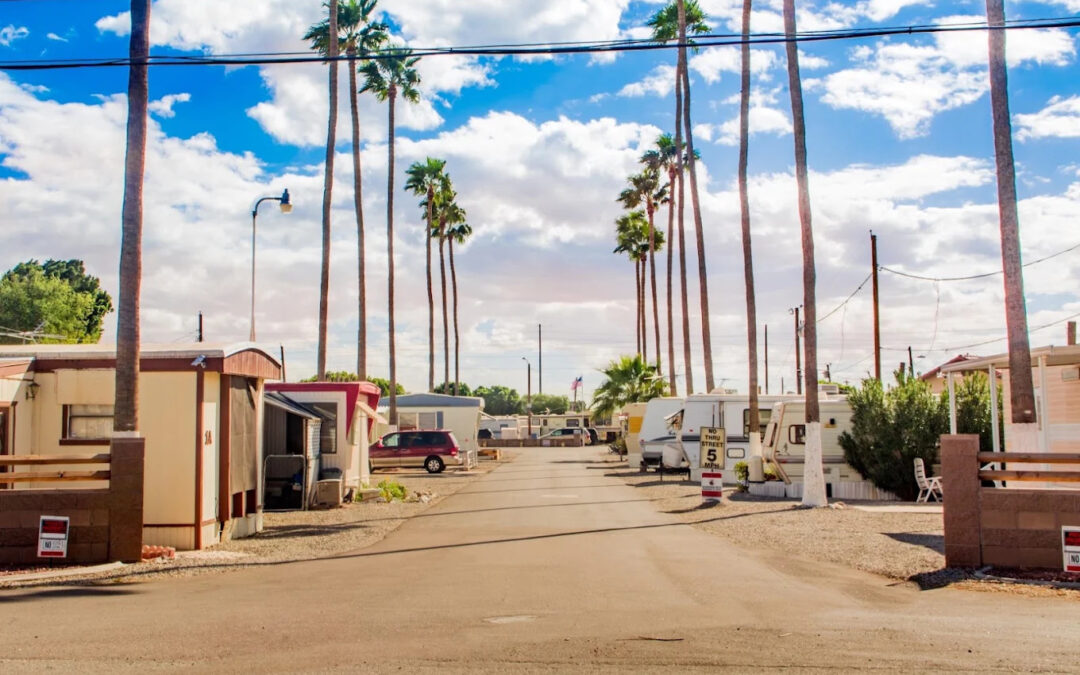
A park model rental is a rental of a small RV-type home in a park, either a furnished unit that a park or owner rents to you or a space where you place your own, and it can run for a season or for a longer term. Arizona defines a park model or park trailer as a recreational vehicle built on a single chassis, mounted on wheels or originally mounted on wheels, designed to connect to utilities for its installed fixtures and appliances, with a gross trailer area of 320 to 400 square feet when set up. Length of stay matters because Arizona’s long-term RV rental law generally applies when the same tenant rents a qualifying RV space for more than 180 consecutive days, and for a park model or park trailer in an RV or mobile home park it applies to the space rental even without a signed agreement, though whether a furnished unit rental falls within the law can depend on the arrangement, so confirm your situation with an Arizona attorney.
Why Does “Park Model Rental” Mean Two Different Things?
Park model rental listings in Yuma generally describe two different arrangements. Some offer a furnished unit that you rent along with its space. Others offer a space for a park model you already own.
In the first, you rent the home and the ground under it, and you bring a suitcase. In the second, you bring the home and rent only the ground. Each arrangement has different costs, responsibilities and paperwork.
The length of the stay matters just as much. A winter stay and a stay that runs for most of a year are not treated the same way in Arizona, and the difference can change your rights as a tenant.
This guide explains how park model rentals work in plain words, with Arizona rules where they apply. It is general information, not legal advice, so for a specific rental, talk to an Arizona attorney who handles landlord and tenant law.
What Is a Park Model, and How Is It Different From an RV or a Mobile Home?
A park model is a small home built on a single chassis and designed to connect to utilities. Arizona’s definition covers a unit that is mounted on wheels or was originally mounted on wheels, so a park model does not stop being one when its wheels come off. The gross area is 320 to 400 square feet when it is set up, and the definition does not include fifth wheel trailers.
Arizona counts a park model as a kind of recreational vehicle, even when it stays in one spot. A mobile home is a different category. The long-term RV rental law does not apply to mobile homes or manufactured homes, which is one reason the label on the unit matters.
Some listings use “park model” loosely, so confirm the unit’s classification with the owner or the park. Ask for its size and age, and whether it is a park model, a park trailer or something else. Ask for photos of the inside and outside, and see the unit before you pay if you can.
What Does Renting a Park Model Actually Mean?
A vague listing can leave out the most basic facts. Three questions clear it up. Am I renting the unit, the space or both? Who owns and maintains the unit? Which utilities and services does the quoted rent include?
If you rent a furnished unit, the park or owner supplies the home. You pay rent for the unit and the space together, and the lease says what is included. Your questions are about the home: what furniture comes with it, who repairs the air conditioner, and whether the rent covers utilities.
If you rent a space for your own park model, you supply the home. You pay rent for the ground, and the agreement says what the park provides in return. Your questions are about the park: does it accept your unit, what does the space rent cover, and how does it bill utilities.
One caution applies to the first arrangement. Arizona’s long-term RV rental law is written about renting a space. Whether it also covers a furnished park model that a park rents to you together with the space can depend on the specific arrangement, so confirm it with an Arizona attorney before you rely on it.
How Do Seasonal and Long-Term Rentals Differ?
How long does a seasonal stay last?
Yuma has a clear winter season, and a study of one past season gives some context. In a study of the 2017 to 2018 season, RV park winter visitors who stayed 30 days or more in Yuma County averaged 118 nights, and October and November were the most common arrival months while March and April were the most common departure months.
Treat that as background and not as a current estimate or a rule for how long visitors rent today. It covers one season, and it measures visitors, not rental terms.
Four dates can differ for the same stay: the dates a park offers rentals, the minimum booking period, the days you actually occupy the unit, and the cancellation deadline. A seasonal package may not match your exact arrival and departure, so compare your own dates with the park’s terms.
Where does the 180-day line fall?
Arizona’s long-term RV rental law uses a clear cutoff, and it focuses on the space and the tenant. It generally applies when the same tenant rents a qualifying RV space for more than 180 consecutive days. For a park model or park trailer in an RV or mobile home park, it applies when the same tenant rents the space for more than 180 consecutive days, and no written agreement is required. The law does not apply to mobile homes or manufactured homes, or to a property with one or two RV rental spaces.
You can test your own dates with a calendar. A stay from December 1 through March 31 is 121 days, which is under 180. A stay from October 1 through April 30 is 212 days, which is over it. Other dates will land elsewhere, so count your own.
The 180-day line decides whether the long-term RV rental law applies to a qualifying space rental. It does not, by itself, answer every legal question about a furnished rental, the unit itself or the terms of your agreement. If your arrangement is unusual, get advice specific to it before you rely on the law.
What changes if the law applies to your space?
Utility billing is one place where that law has its own rules. A landlord may charge separately for gas, water or electricity by submetering or by ratio utility billing, but a landlord that is also a mobile home park as Arizona defines it must use submetering and follow the submetering rules.
Under that law, a park that uses ratio billing may charge an administrative fee for its actual administrative costs. The monthly fee cannot exceed the greater of those costs or 10 percent of the utility provider’s monthly charges to the park in the aggregate, and third-party billing charges have a 10 percent limit of their own. The rental agreement must list the utilities that are charged separately and say that the fee applies, and the park must post the current rate and the costs behind the fee.
The same section covers overcharges. If a park finds an overcharge, on its own or after a tenant objects, it must refund the tenants who still live there within 60 days. If you think the park is not following this section, you must first give it written notice, and if the dispute is not settled within 30 days you may file a civil complaint in justice court.
What Should You Check Before You Pay a Deposit?
Use your first call to confirm the basic terms. What is the minimum stay, and what are the start and end dates? What does the rent include, and who pays for electricity and propane? Is the unit furnished, and does a list come with it? Are pets allowed, and is there a fee? What is the deposit, when is it refunded, and what are the cancellation terms?
Find out who the landlord is, and whether the park or a private owner is renting the unit. Ask for the rental agreement and the park’s written rules, and read them before you send money. A listing is not an agreement. Written terms help you clarify the deal and keep a record, but they do not by themselves settle which law applies, so have an attorney review anything large.
Also ask what happens if your plans change. If you leave early, what do you still owe? If something breaks and the park cannot fix it, what happens to your rent?
What should you inspect in the unit?
If possible, visit at different times of day to judge noise, shade and the surrounding area. When you see the unit, go through a short list:
- Test the air conditioning and the heating
- Run the taps and check the water pressure and drainage
- Check the refrigerator, the stove and any other included appliances
- Look for leaks, musty smells and damaged flooring
- Compare the furniture and appliances with the list you were given
- Photograph any damage that is already there before you move in
How do you compare two rentals?
Compare the cost of the whole stay, not just the monthly rent. Write down the monthly rent, the months you plan to stay, the deposit, any pet or other fees, and your best estimate of electricity and propane. Ask for typical bills from the same unit in the same months, and mark any figure you cannot get as unknown, not zero.
The table below uses hypothetical figures for illustration only. They are not Yuma prices.
| Cost item | Rental A | Rental B |
| Monthly rent | $1,000 | $900 |
| Utilities | Included | Electricity about $150 and propane about $50 a month |
| Deposit | $300 | $300 |
| Pet fee | None | $100 |
| Total for four months | $4,300 | $4,800 |
Rental B has the lower rent and costs more over the same four months. Rental A’s total is $4,000 in rent plus the $300 deposit. Rental B’s total is $3,600 in rent, $800 in utilities, the $300 deposit and the $100 fee. Add up your own lines, and write the terms next to each total, because a minimum stay or cancellation rule can rule out a rental that looks cheap.
Which Fits You, Seasonal or Long-Term?
A seasonal rental suits someone who wants a few warm months and a clear end date. A longer stay suits someone who wants a home base that lasts beyond a winter.
| Seasonal stay | Long-term stay | |
| Typical length | A few months, such as a winter | Longer than 180 consecutive days |
| Where the 180-day line falls | Often under it, depending on your dates | Over it |
| The long-term RV law and the space | May fall outside it | May apply to the qualifying space rental |
| What to settle first | Minimum stay, cancellation and refund terms | Term, rent changes and utility billing |
Choose the option that fits your dates, budget and rental terms. How many months do you plan to stay, and how firm are those dates? Do you want a place you can return to next season, or a fresh start each year? And can you accept the cancellation and deposit terms if your plans change?
Can a 55+ Park Offer a Furnished Option?
Some travelers want a furnished place and no move at all. A furnished home that is already in a park skips the work of finding and placing a unit.
Goldwater Estates in Yuma is a 55+ RV and mobile home park. Its For Sale and For Rent page has shown furnished mobile homes for sale and for rent. A mobile home is a different unit from a park model, so call the office to ask what is open now, what the rent includes, and whether any park models are available or accepted on a rented space. Homes sell and prices change, and a 55+ park has an age rule, so ask how it applies to everyone in your party.
Pros and Cons of Renting a Park Model
Pros:
- You can try a place for a season without buying a home
- A furnished unit means you do not have to move or place a home yourself
- Arizona’s long-term RV rental law gives tenants rules on utility billing, refunds and complaints when it applies
Cons:
- Terms and costs vary by park and by owner, so you must compare them
- Whether the long-term RV rental law applies depends on the length of stay and the arrangement
- Electricity, propane or other utilities may be billed on top of the rent
- Cancellation and deposit terms can cost you if your plans change
Conclusion
Park model rentals in Yuma come in two forms. You either rent a furnished unit or you rent a space for your own. The length of your stay can decide which Arizona rules apply to a qualifying space rental, and the line sits at 180 consecutive days.
If you are considering Goldwater Estates, contact the office at (928) 919-7035 to ask about current furnished mobile home rentals, space availability and the terms for your planned stay. Confirm whether the available option matches the type of accommodation you need. This guide is general information, so have an Arizona attorney review any rental that involves a large deposit or a long stay.
Frequently Asked Questions
Can I rent a park model just for the winter?
That depends on the park or the owner. Check the minimum stay, the start and end dates, what the rent includes and the cancellation terms. If the minimum stay is longer than your plans, ask whether different terms are possible.
What is the difference between a park model and an RV?
Under Arizona’s definition, a park model is one kind of recreational vehicle. It is built on a single chassis, mounted on wheels or originally mounted on wheels, and has a gross trailer area of 320 to 400 square feet when set up. A travel trailer or motorhome is a different kind of RV.
Does Arizona’s long-term RV law cover short stays?
The law generally applies when the same tenant rents a qualifying RV space, or a park model space, for more than 180 consecutive days. A stay of three or four months is under that line. How the law applies to a furnished unit rental can depend on the arrangement, so ask an Arizona attorney about yours.
What should a furnished rental include?
Ask for a written list that names the furniture, the appliances and the heating and cooling, and says who maintains each one. Compare it with the unit when you arrive and report any difference right away.
Do I need to be 55 or older to rent in a 55+ park?
It depends on the park. A 55+ park has an age rule, so ask how it applies to everyone in your party before you apply or pay a deposit.
Can I rent a space for my own park model?
Some parks accept them and some do not. Ask whether the park accepts your unit, what the space rent covers and how it bills utilities. If you plan to stay more than 180 consecutive days, Arizona’s long-term RV rental law may apply to the space.
Further Reading
What Should First-Time Buyers Know About Mobile Homes in Yuma?
Recent Comments