
The listed rent is only one part of the decision. Start with three yes-or-no checks that can remove a park from your list, which are whether it accepts your household, whether it accepts your home, and whether you can afford the total cost. Then compare the parks that remain on six things, and comparing the same factors makes the trade-offs easier to see.
| What to compare | Why it matters |
| Cost clarity | Two parks with the same rent can bill very different extras |
| Written rules | Rules on homes, pets, guests and vehicles shape daily life |
| Utility billing | Meters, rates and billing method change your monthly total |
| Location | Drive times and surroundings affect your daily routine |
| Management | You need to know who handles notices, payments and repairs |
| Site condition | Roads, lighting and shared areas show how the park is kept |
Why Is a Park Listing So Hard to Compare?
Search for mobile home parks in Yuma AZ and you get a long list of names, addresses and photos.
A listing shows you where a park is. It rarely shows what matters once you live there, such as what the rent covers, how the park bills for water and electricity, and what its rules say about guests and pets.
Two parks can list the same rent and still cost very different amounts. One may fold water, sewer and trash into the rent. The other may bill all three on top.
This guide gives you one method you can use on any park, whether you plan to buy a home and rent the space under it or rent a home that is already there. You ask each park the same questions, write down the answers and compare them side by side.
It is general information, not legal advice, so for a specific purchase or rental, talk to an Arizona attorney who handles mobile home park law.
What Kinds of Mobile Home Parks Are There in Yuma?
Before comparing prices, check the park’s rules, the type of space it offers and whether you plan to rent a home or bring your own.
Start with who the park is for. For a rental covered by Arizona’s mobile home park law, the landlord must give a statement of policy before the rental agreement is signed, and it must be attached to the rental agreement. The statement says whether the park is a family community or a community for older persons. It also covers how long before any change in the park’s use is expected, how rent changes are determined, and any right of first refusal given to tenants if the park is sold and the conditions for using it. Finally, it covers the size and kind of homes the park allows, any required improvements and their estimated cost, and who must insure the home.
Then look at the spaces. Arizona defines a mobile home park as a parcel with four or more mobile home spaces, and its definition of a mobile home excludes recreational vehicles and certain park model trailers. A park may accommodate more than one type of unit, but that does not mean the same rental rules apply to every space. Confirm how your unit is classified and which rules govern your arrangement before relying on any requirement in this guide.
Finally, think about how you will live there. Some people own a home and rent only the space under it. Others rent a home that someone else owns. If you bring or move your own home, you may face transport, setup and permit costs. If you rent a home already in the park, the agreement decides who handles repairs and other responsibilities. Neither arrangement is always cheaper or safer, because that depends on the home, the term and the contract.
What Should You Compare First?
Will the park accept your household? Age restrictions can rule out a park before you compare costs or amenities. Will it accept your specific home, or the unit you want to rent? And can you afford the total expected cost?
If any answer is no, drop that park. If any answer is unknown, find out before you decide. This order helps you rule out unsuitable parks before spending time on visits. Only the parks that pass go on to the six-factor comparison below.
How Do You Compare the Real Monthly Cost?
What does the space rent cover?
Space rent pays for the right to keep your home on that space. What else it covers comes from the agreement. Ask each park whether the rent includes water, sewer and trash, electricity and gas, cable or internet, upkeep of roads and lighting, shared areas and amenities, and the on-site office. Ask where the agreement says so.
A clear answer names the item and says who pays.
How are utilities billed?
For a rental covered by Arizona’s mobile home park law, there are specific rules for utilities that the landlord bills separately. For separately billed gas, water or electricity, the law requires a separate meter for each user and caps the charge at the prevailing basic service single family residential rate, and separately billed trash and sewer service is capped at the prevailing single family residential charge.
The bill must also show the charge for each period, the opening and closing meter readings with their dates, and how the charge was calculated. Ask each park for a sample bill and confirm how these rules apply to your rental.
If utilities are included in the rent, check the agreement to see exactly which services are included and whether any separate charges can still apply.
What do the posted rates and the rent history tell you?
For a rental covered by Arizona’s mobile home park law, the landlord must post the current utility rates in a conspicuous place unless the utility company bills the tenant directly, must give a prospective tenant on an initial rental agreement a written statement of basic space rent increases for the three full calendar years before the agreement, and must disclose in writing the name and address of the owner and of the person authorized to manage the premises. These disclosures come before the rental agreement is entered into.
The park may give the rent history as an average across the park, so one space’s history could differ from the figure you see. It tells you how the park has behaved, not what it will do next.
How do you add up the total cost?
Use one formula for every park. Monthly comparison cost equals space or home rent, plus separately billed utilities, plus recurring fees, plus the monthly equivalent of one-time costs.
Keep one-time costs, such as a deposit, an application fee, moving or setup, in their own line first. Then spread them over the months you expect to stay. For example, a one-time cost of $1,200 spread over 24 months adds $50 a month. That figure is arithmetic only, not a Yuma price.
If a figure is unknown, mark it unknown, not zero. If you plan to buy a home, ask the seller what taxes and recurring charges they pay now, and confirm the applicable assessment and tax treatment with the county office. Ask the park for every recurring charge and for any required improvements or setup work.
How Do You Compare Rules and Who Is Allowed?
Which documents should you collect?
Collect the same papers from every park. Not every document applies to every rental, so the table notes when each one does.
| Document | When it applies |
| Rental agreement or purchase papers | Every rental or purchase |
| Written park rules | Every park |
| Statement of policy | A rental covered by Arizona’s mobile home park law |
| Written summary of the Act | An initial rental agreement covered by that law |
| Rent history statement | An initial rental agreement covered by that law |
| Owner and manager disclosure | A rental covered by that law |
| Utility rates and a sample bill | Wherever the park bills utilities |
| Written confirmation that your home is accepted | If you bring or buy a home |
| List of required improvements, permits and setup costs | If you bring or buy a home |
| Schedule of recurring and one-time fees | Every park |
The summary row comes from the same section as the rent history. The section also requires a landlord to give a prospective tenant the state-approved concise summary of the Act before entering a rental agreement. Ask for it and read it with the agreement, the rules and the statement of policy.
What does the age rule mean for your household?
Some parks restrict residency by age. When a park calls itself 55+, ask to see its written occupancy and guest rules before you rely on the label, and ask how those rules treat everyone who will live with you. Also ask about visitors, a grandchild’s short stay and what happens if your household changes later. The label alone does not tell you whether a particular resident or guest is allowed.
Will the park accept your home?
If you are buying a home to put in a park, or moving one, get the park’s answer on that specific home before you pay for it. Give the park the home’s dimensions and type, its age and condition if the park sets standards, and any improvements or additions you plan. Ask what setup, anchoring, utility connections and permits apply.
Requirements depend on the home, the property and local rules, so get the answer in writing.
How Do You Compare Location and Seasons?
Location is easy to judge on a map and hard to judge on foot. Time the drive from each park to the places you use most, such as your doctor, your pharmacy and the grocery store. Then visit at two different times of day, and note the road noise, the lighting and how busy the park feels.
Yuma also has a clear winter season. In a study of the 2017 to 2018 season, RV park winter visitors who stayed 30 days or more in Yuma County most often arrived in October and November and most often left in March and April.
That study is historical and covers RV park visitors, so it does not show how any one park behaves today. It does suggest a question: how does the park feel in winter? Ask how full it gets, whether the rent or the rules change in the busy months, and whether the park is open all year.
Local zoning and placement rules can also matter, and requirements may differ between a property inside the City of Yuma and one in unincorporated Yuma County. If you plan to bring or move a home, confirm the property’s jurisdiction and ask the relevant planning or building department which placement, permit and setup requirements apply to that specific home and space.
How Do You Score Parks Side by Side?
A scorecard keeps you from choosing the park with the nicest photos. Fill in one column per park and use the same factors each time.
First, answer the three yes-or-no checks. Write yes, no or unknown for each park.
| Check | Park A | Park B |
| Accepts my household | Yes, no or unknown | Yes, no or unknown |
| Accepts my specific home or the unit I want | Yes, no or unknown | Yes, no or unknown |
| Total expected cost is affordable | Yes, no or unknown | Yes, no or unknown |
Drop any park with a no. For the parks that remain, score each factor from 1 to 5 using the meaning in the middle column.
| Factor | What a 5 means | Park A | Park B |
| Cost clarity | Rent, utilities and fees are clearly disclosed and fit your budget | Score | Score |
| Written rules | The documents are available and easy to understand | Score | Score |
| Utility billing | Rates, billing method and a sample bill are available | Score | Score |
| Location | Drive times and surroundings suit your routine | Score | Score |
| Management | You know who manages the park and how to reach them | Score | Score |
| Site condition | Roads, lighting and shared areas meet your needs | Score | Score |
| Total out of 30 | Add the six scores | Total | Total |
If a factor is still unknown, leave it marked unknown and note what you are waiting for. Do not give a park a low score only because the manager has not replied yet.
Use the scorecard to compare parks, not to replace your checks. Do not choose a park while a major question about home acceptance, total cost, written terms or required permits remains unresolved.
What Should Make You Cross a Park Off the List?
Treat a refusal to provide the relevant written terms before payment as a serious warning. So are answers that change from one call to the next, and a park that cannot say who owns or manages it.
Be cautious if a park bills for utilities but will not show you the rates, the billing method or a sample bill. Be cautious too if someone pushes you to decide quickly, or if a rent is far below every other park with no reason given.
Visible neglect counts as well, such as standing water, debris, dark streets or broken common areas. A casual walk through a park is a first check. It cannot tell you whether the park meets building, plumbing, electrical or health requirements.
Where Does a 55+ RV and Mobile Home Park Fit In?
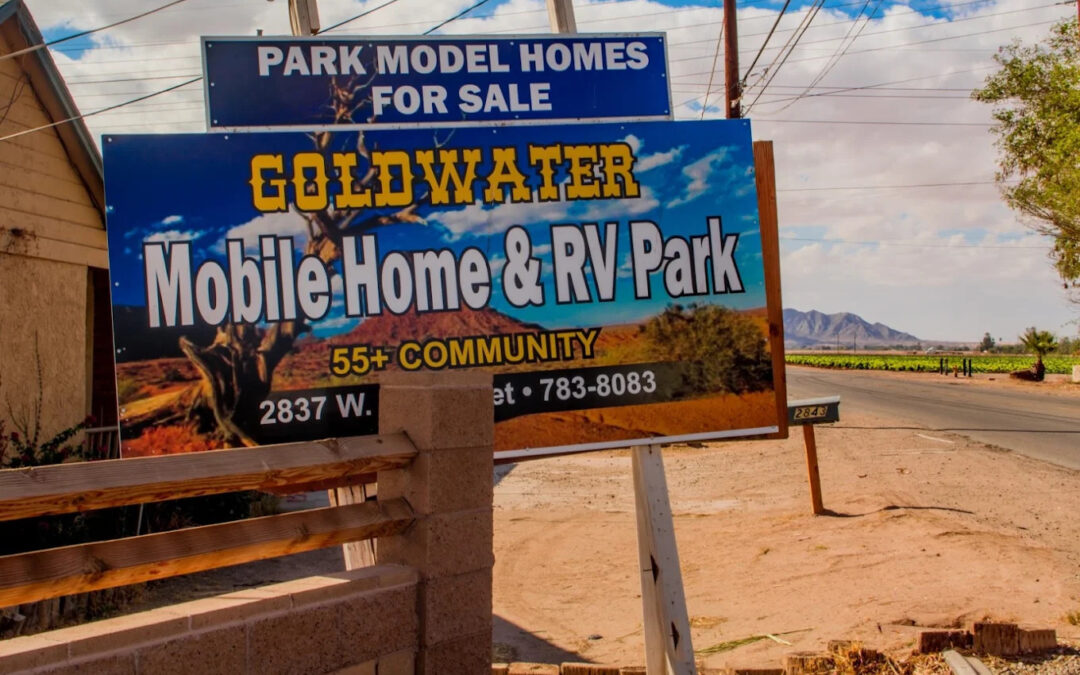
Goldwater Estates in Yuma is a 55+ RV and mobile home park, and it is one option to consider as you compare communities. Its For Sale and For Rent page has shown furnished mobile homes for sale and for rent. Check the current listings and contact the office to confirm availability, rent, utilities and occupancy rules, since homes sell and prices change. Compare what you learn with the same criteria you use for every other park.
Pros and Cons of Living in a Mobile Home Park
Pros:
- You can own your home without buying the land under it
- The park looks after the shared parts of the community that its agreement lists
- Written rules and a statement of policy give you something to compare across parks
- A furnished home lets you test a park before you commit to buying
Cons:
- Space rent is an ongoing cost that you do not control
- The park’s rules limit guests, pets, vehicles and sometimes who can live there
- Utilities and other charges may sit on top of the listed rent
- You do not build equity in the land under your home
Conclusion
The best mobile home park for you is the one that accepts your household and your home, shows you its costs and rules clearly, and fits how you live. Run the three yes-or-no checks, score the parks that remain on the same six factors, and keep the answers on one scorecard.
To ask about current options at Goldwater Estates, you can call the office at (928) 919-7035. This guide is general information, so have an Arizona attorney review anything that affects a large purchase or a long stay.
Frequently Asked Questions
Are all mobile home parks in Yuma 55+?
Not necessarily. Each park sets its own rules, and its statement of policy says whether it is a family community or a community for older persons.
What is the difference between space rent and a mortgage?
A mortgage pays for a home you are buying. Space rent pays a landlord for the land under your home.
Does space rent include utilities?
It depends on the agreement. If the park bills gas, water or electricity separately, ask for the rates and a sample bill, and see the utility billing section above.
How do I find out whether a park will accept my home?
Ask for the statement of policy, then get the park’s written answer on your specific home before you buy or move it.
Should I rent a home in a park before buying one?
It can show you what daily life in the park is like, if a furnished home is available. Ask what the rental includes and how long the term runs.
Can I compare parks without visiting?
You can narrow the list by phone and email, but visit before you pay. A visit helps you judge the surroundings, noise and shared areas in a way photos cannot.
Recent Comments